
This is the first in a series of articles on living to 100 and beyond. This post was originally published on May 17, 2010.
Ever since time immemorial, humans have been born, they age, and one day, they die. Each of us is blessed with only a few short decades of youth; it’s all downhill from there. Indeed, retirement at the age of 65 seems almost cruel when you think about it: Most of your youth is already gone, and many of your retirement years will be spent visiting your new best friend, the doctor, and watching life pass you by as friends and family slowly pass on. Of course, there is joy, too, such as the freedom of finally being free from work, while being able to enjoy the company of children and grandchildren.
What if we didn’t have to suffer the consequences of aging; what if things didn’t have to be this way? What if one day, each passing year meant an increase in your personal expected lifespan? What if we were even able to reverse the processes of aging, so that you could be restored to youthful vigor and vitality? Sounds like wishful thinking? Ever since the beginning of time, people have been searching for the Fountain of Youth. It hasn’t yet been discovered, but in the future, maybe a miraculous fountain won’t be needed.
New Orleans Mardi Gras 1907. Illustration showing title float for Momus parade. “The Quest for the Fountain of Youth”. Source: http://nutrias.org/~nopl/monthly/february2007/february2007.htm
By now, you are probably asking yourself, “what is this guy on?” Well, I am simply talking about the singularity. To explain what the singularity is, one first has to look at the general technological trends. Take a look at the time elapsed since major events in our history:
Agricultural revolution: ~10 000 years
Bronze age: ~4 000 years
Iron age: ~3 000 years
Widespread use of gunpowder; widespread sailing across the oceans: ~500 years
Industrial revolution: ~200 years
Flight; automobiles: ~100 years
TV: ~70 years
Transatlantic flight: ~50 years
Lunar landing: ~40 years
Beginning of widespread Internet use (information revolution?): ~15 years
Arriving at the singularity
As you can see, the pace of technological advance has been accelerating. The amount of change in the last 100 years alone is simply incredible, compared to all of the centuries before. It’s hard to comprehend the vast amount of change for those of us who have only been around a couple of decades, but if you had been born 100 years ago, then there would be no TV, no Internet, no international flights, no nuclear power plants… we have changed the world tremendously in the past 100 years.
As a species, we have greatly reduced the incidence of disease, we have greatly increased the dissemination of information; heck, in spite of all the bad news that you read about, the human race has built an amazing wealth of capital and technology. We stand on the shoulders of giants, of all those who have come before us and contributed to the accumulation of knowledge and progress. We’ve stumbled along the way, too, especially in the first half of this century with two world wars and with clashes of irreconcilable ideologies, but this doesn’t mean that we haven’t made a great deal of progress, in spite of the challenges that we have faced.
Given the improvements to our living conditions and to lifespans, why is it that we still imagine our later years as being more or less similar to how they’ve always been? Surely with all the change in the past 100 years, the change coming up is going to be even more incredible. It’s just hard to see, since we are actually living through these times and experiencing the progression of history first hand.


So, is this really what is still in store for us? Maybe not anymore. One guy who has put a great deal of thought into these ideas is Ray Kurzweil; you can read more about his thoughts on the singularity at his site, KurzweilAI.net.
The retirement plan
So, what does this mean for our retirement plan? First, let’s take a look at how retirement plans are often done today. The usual retirement plan takes a regular savings plan and places a few assumptions on it, such as a compound annual return of 8%, a retirement age of 65 or before, and a life expectancy of another 15-20 years beyond that. The savings built up over time are drawn down during retirement, and it looks something like this:
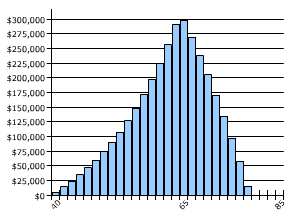
Traditional retirement plan. Prepared with MSN MoneyCentral.
There are a few issues with this sort of a plan:
- What happens if you live “too long”? You no longer have any retirement savings.
- What if your income changes over time? There is no longer a full-time work guarantee for many of us.
- Do you really want to settle for a “so-so” retirement, watching your nest egg dwindle with each passing day?
When investigating your options for increasing your available cash during retirement a reverse home loan is one option you should consider. More commonly referred to as a reverse-mortgage, such a loan works differently from traditional lending agreements, which require monthly repayment of part of the funds involved. When you sign up for a reverse mortgage you will receive monthly payments out of the equity value of your home rather than having to make payments back to your lender. Such an option can help you during your retirement because you will have ready cash and the flexibility to spend those funds on anything you may want or need to make your retirement easier.
In order to fully capitalize on the potential advantages of longer lifespans, the above approach clearly won’t work too well. Our graph should look more like the following:

Retirement seed. Prepared with MSN MoneyCentral.
How can we get here? In order to achieve this, we can’t stick with a traditional plan, but we have to take the call to action and go above and beyond that. There are a few key points that will help form the foundation of this new retirement plan:
- Reducing expenses (Yakezie blog).
- Growing a money tree of savings.
- Building passive income (Yakezie blog).
In my next post, I will talk more about the lifestyle and expectation changes, as well as how a longer lifespan changes investing strategies. What do you think about the coming changes, and how will it impact your retirement strategy?
Further reading:
- Fantastic Voyage: Live Long Enough to Live Forever
(Amazon affiliate link) - Transcend: Nine Steps to Living Well Forever
(Amazon affiliate link) - Accelerando (Singularity)
(Amazon affiliate link) - KurzweilAI.net: Bootstrapping our way to an ageless future (online article)
- Foresight Institute: Improving Health and Longevity (online article)
- The Wise Buck: How To Achieve Financial Independence (blog)
- Andrew Hallam: How to Retire Rich–Even if You’re Not – Malaysia (blog)
Originally published on May 17, 2010.


Hey Kevin,
This is another well-written post. Well done!
I base my “amount needed”on what I figure I’d need today. Then I compound that out by about 3% annually to cover inflation, and then I multiply that figure by 25. This allows me to withdraw 4% of my portfolio during the first year, and then it allows me to give myself slight raises each year to cover inflation.
For example, if I’d like $60,000 annually today, and I’ll be retiring in 5 years, then that $60,000 today will be the projected equivalent of $69,556 in terms of buying power 5 years from now.
To be able to withdraw a base 4% from my portfolio each year, it equates to me needing a portfolio value of $1,738,911 in 2015.
For me, though, I could live on a relative shoestring in South East Asia for most of the year. It’s my wife I have to keep happy–so we’ll need that $1.7 million. Sigh…
I look forward to your comments and your next relative post.
Cheers,
Andrew
.-= Andrew Hallam´s last blog ..Vanguard Investments for Canadians – Why Not? =-.
I used a very similar process. I want to retire by 55 and be on an annual salary of about £70,000 per year. I’ve estimated that I will therefore need a pot of about £3.5million. Got some way to go yet!
Favorite line – “watching your nest egg dwindle with each passing day”.
The problem I have (and posted about) with retirement savings is its like projecting an eventual death age and assuming a static lifestyle. Given how dynamic life is, why do people assume this?
.-= FinEngr´s last blog ..Don’t Be Fooled by Sneaky Labeling! =-.
William Bernstein talks about this in his book, The Four Pillars of Investing. Based on historical market scenarios, whether your money lasts 15-20 years or whether it lasts forever only involves an overall portfolio size difference of about 25%. In others words, $1 million might last 15-20 years for a certain person, but $1.25K would hypothetically last them forever. I think you have to work it out as if you’re going to last forever. You never know who might turn into Connor McLeod of the clan McLeod at the last possible moment.
.-= Andrew Hallam´s last blog ..Vanguard Investments for Canadians – Why Not? =-.
@Andrew
Yep, always gotta keep the significant other happy if you want harmony! 😉 That’s interesting about 25% more; I have to take a look at that. The portion that you’re using to live off of won’t be returning 8%+ (well, it could, but then you’re opening yourself up to fairly big swings in income) but more like 4-5%, so after keeping up with inflation the margin seems pretty thin.
@FinEngr
Those are my thoughts as well; in fact, I don’t even see retirement as a hard line, but rather a goal and lifestyle i’d like to ease myself into. Each step that brings me closer to financial independence is one in the right direction. Planning for retirement in the traditional sense is kind of like planning to wither away and die; I’m planning for life, and for a bright future ahead!
As always, thanks for the great feedback, guys!
Cool article. I wrote one about living to 150 more recently when some scientist proclaimed aging will be treated more as a “condition” like diabetes and such rather than our ultimate demise. Some of my key concerns would be how the demographic shifts would alter society – most of the world would be ‘old” instead of young, thus shifting the priority of resources – and causing major generational divides.
The demographic will be a big shift. Can you imagine collecting SS for more than half of your entire lifespan? We are going to have to rethink this and more — and start saving a lot more capital for our future, because we’re going to need it.
P.S. Please let me know the link; I will be happy to include it above.
Hey Kevin ,
Awesome post! Definitely don’t think you’re on something…lol
You bring up valid points people should think about.
Thanks for checking out the posts! 🙂
Some good food for thought!
We plan to live off of our investment earnings when we retire – and plan not to touch the principal at all. Hopefully this will allow us to live comfortably, no matter how long we live – and then we can pass on the nest egg to our children and set them up for an early retirement too!
I like this plan! Just check that you adjust the notion of “principal” upwards to account for inflation, since you’re interested in preserving real capital, not nominal.
Nice re-post. This is a great topic that deserves another round in the spotlight.
I have a simple solution to perpetuating my retirement to age +100 and beyond. Instead of the traditional 4% withdrawal, my money design is to use only 2 to 3%. Even if I have a conservative portfolio earning 5 to 6%, it should continue indefinitely.
I think that 2% to 3% is safer for sure. 4% can lead to the money running out if the economy runs into some hard times and you don’t adjust spending downwards.
My colleague and I were just discussing long lives the other day. Her neighbor had two boys recently and their pediatrician estimated their lives at over 100 (which neither of us could see how he came up with that number). But my comment to her was what about retirement? 65 won’t be “the golden age” if you live to 105 or 110! Half your life would be working and nearly the other half would be in retirement. That’s a lot of cash you’d have to save up. Maybe this is why retirement age is slowly creeping up into the 70’s.
It makes sense! Probably makes it a good idea to save more, today. 😉
Like a few people already hinted at hear – retirement is such a wiggly moving target. I mean with the advancement of medical science I plan on being a spry 150 and my hope is that my portfolio will be able to keep up. By that time though something to think about is the number of working generations that my direct decedents. Within the last few decades family’s are reported to be closer and share a greater of number of resources. In a worse case scenario I will hopefully be able to rely on my family’s support – not the best plan at 150 but it could be better then waiting on a Social Security Check.
I wonder what “retirement” will be like in 30-40 years when I’m in that time frame. Could be totally different by then!
Our government is in major dilemma. Life expectancy keeps going up while workers to retirees ration keeps going down. End result is not having enough money for millions of those who believe that social security is their life line. You have to live way below your means to ensure happy life beyond 80, let alone 100.
The can can be kicked, but eventually the road ends.
A gun and a bullet costs $200. If I live past 80, I will only need $200. Okay, inflation adjusted, it will be $500 then. So I need $500.
Haha, a little morbid! I do think that medicine will “cure” aging within the next few decades, which might be comfort to you if you’re a long ways from 80.
Damn, young people think it’s tough to get a job these days… imagine when people are working until 80 or 90 because they have nothing saved for retirement. There will be no jobs for 20 and 30 somethings, let alone what we’re seeing now with seniors taking jobs teenagers would normally fulfill.
Kind of scary the times we’re going into. I wonder how far the debt charade can go… the world in 20-30 years might be very different.