
Last week, I introduced gold and talked about the allure of this precious metal. Due to gold’s spectacular rise in recent years, interest in the yellow metal has been increasing. Ever since the 2008 financial crisis and the subsequent efforts of governments to stimulate their economies, people have been increasingly taking a hard look at the way that their governments spend their money, and some of them have started to buy gold as a hedge. Greece is now in serious trouble raising money in the markets, because investors are losing confidence that Greece will be able to pay back its debts in the future.
The same forces are at work in the U.S., which is spending unbelievable amounts of money and has a colossal amount of debt. In percentage terms, the situation is not quite as bad as Greece, but the current path of the US is certainly headed that way, and a loss of confidence in the U.S dollar could make 2008 look like a joke. It is this increasing awareness of this sovereign risk that is fueling the rise of gold and precious metals in general.
So, how has gold actually performed over the years? This is what I will analyze in this post. By 1975, the limitation on gold ownership was repealed, and it became legal for U.S citizens to own gold once again (yes, it was actually illegal before this time period, ever since the Great Depression). Here is how I will set up this analysis:
- I will compare the performance of gold against the total returns of the Wilshire 5000 stock market index, which tracks the returns of all stocks actively traded in the U.S. markets.
- Starting in 1975, our fictional investor will invest $1 000 in gold every year, at the beginning of the year, at the London P.M fix price. This $1 000 will increase by 3% per year.
- The same amount of cash will also be invested in units of the Wilshire 5000 index.
For example, if gold is $800/oz and the Wilshire 5000 index is at 40, then $1 000 will buy you 1.25 ounces of gold and 25 units of the Wilshire 5000 index. At the current valuation, both are worth $1 000. For the purposes of this analysis, I will not look at physical storage fees or assay/fabrication costs in the case of gold, nor will I look at stock brokerage fees or management expense ratios in the case of the Wilshire 5000. Also, I will assume that our fictional investor has access to an investment method which allows him to invest in fractional ounces of gold.
Sources for the following analysis:
- Gold prices from Kitco, based on the London PM fix.
- Wilshire 5000 index values from Wilshire, historical index values.
- Federal Reserve interest rates from the Federal Reserve, Federal funds effective rate.
First, let’s take a look at how both gold and the Wilshire 5000 have performed over the years:


Gold had a brief spike in value in the early 1980s; it then stagnated for more than 20 years until the early 2000s. Since then, gold has been on a tear. The stock market on the other hand made steady gains throughout the 80s and 90s, and curved strongly upwards after 1995. The market has hit two walls since then: The IT bubble of 2000 and the financial crisis of 2008. Therefore, the market has been basically stagnant for the entire decade since 2000.

As we can see on this chart, interest rates have been declining ever since their peak in the early 80s, which also coincides with the previous peak in gold. Nowadays, the effective rate is almost 0%, which means that if they want to reduce rates further and stimulate even more, they’re going to have to start paying interest instead of charging interest! It’s interesting territory to be in.

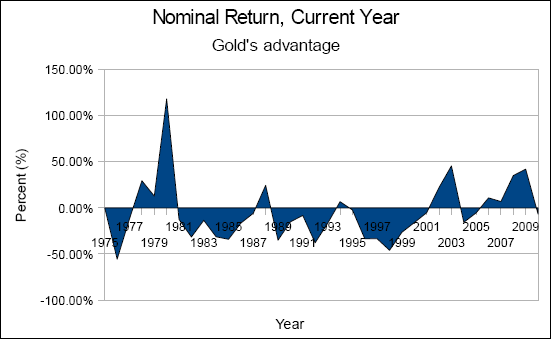
Again, we can see that the 80s and 90s were dog years for gold; gold’s fortunes changed at the beginning of the new millennium.
Let’s see our fictional investor’s performance since 1975:


Even with the market stagnation of the last ten years, the stock market has still managed to perform much better than gold, overall. This is what we would normally expect since stocks represent productive enterprises, producing goods and services and adding value to our world.

Well… what happened! If our investor started investing in 1996, using the same amounts of cash as at the same year in the previous case, then we see gold rocketing past the performance of the stock market. How can this be possible? Gold normally just sits there, looking pretty. How could it have given more value on your money than the entire ensemble of public companies and workers, working hard to produce the goods and services that people pay for?
I think what we are seeing is a loss of confidence in paper assets; understanding why this is happening is key to understanding what is wrong with our economic system and our world today, and why we may still be due for some hard times ahead, barring two significant paradigm shifts and one possibility:
- World productivity increases faster than governments increase spending; advances such as advanced nanotechnology arrive and drastically reduce production costs, providing people around the world with access to cheap goods.
- Our monetary system undergoes a radical shift, using sound currency in place of fiat currency and emphasizing savings over debt.
- Gold is actually in a long, sustained bubble.
While I do believe that advanced nanotechnology is coming, it is still a long way from the promise of material abundance for everybody. As for the second point, I don’t see it happening without a more severe crisis. The entrenched interests have far too much at stake to let it happen voluntarily. It might come through an economic collapse if productivity cannot increase fast enough to support the increased weight of government; this would entail severe social unrest and global political instability.
As for gold being in a bubble, while I don’t completely discount the possibility, I don’t think we are quite there. Firstly, while there is increased awareness of gold today, we’re not at the point where every Joe Blow and his mom is investing in gold, like we saw with the real estate market and the stock market pre-2000. Second, gold’s most valuable purpose to man is as a store of value which can protect against sovereign risk and currency collapse. Given the current state of U.S. finances and of many other countries, this is a very relevant purpose today. Even Richard W. Fisher, president of the Federal Reserve Bank of Dallas, once warned that U.S. policy will lead to “…the mother of all financial storms”. Therefore, the gold price is reflective of this sovereign risk and of the increased desire of people to protect themselves against this risk.
So, is gold in a bubble? Or is there a good reason for its stellar rise in the past decade? Here is some further reading on both sides of the subject:
- Howard Ruff: Think Outside the Box: Maverick Investing in the Age of Obamanomics Par (Investing In Gold and Silver)
- Peter DeGraaf: My expectations for the future.
- Mises Economics Blog: The Current Financial Crisis – and After
- Jon Nadler: Bye-Bye Dubai
- Jon Nadler: Great(er) Expectations and The Unexpected
- Jon Nadler: E.T.F. = Expect Tonnage to Flow. This Is A Two-Way River


This is the best blog posting I have seen in my year+ of blogging. I wrote something similar in one of my postings earlier this year, but it wasn’t nearly as detailed as this.
Fabulous work!
Andrew
Hi Andrew,
Sorry about your comments not appearing; Askimet was being a little hyper-active! Thanks for the feedback; it is greatly appreciated. I have also had the chance to check out a bit of your blog and I am impressed with the success that you guys have been having so far, beating the S&P 500. Let’s see some more continued success through the year!
Thanks Kevin!
My latest post deals with whether beating the S&P 500 takes more luck or more skill. You may have congratulated me for flipping heads 7 times in a row.
I’d love to get your feedback on this one!
Cheers,
Andrew
While it might be easy to do so over a short period of time, it is definitely much harder to consistently beat it over a long period of time. I’ll be sure to go check out your post!
Brilliant post Kevin!
Very informative post, especially the charts. I’ve been investing in gold and silver bullion since 2002. Most of the time when I mention gold as an investment in posts, forums, etc. people don’t want to hear about it.
Charts like these and even those that show how gold is rising against all fiat currencies are surely more than a coincidence.
Mike
Hi Mike,
Thanks for checking out the post! Since you have been investing since 2002, you have had the chance to capture a great deal of bullion’s rise over the last decade. That was certainly a wise decision!
I think people often don’t like to hear about gold because it has a bit of a tarnished reputation in North America. Gold gets part of its “nutty” rep due to the fact that many of the sites talking about gold are rather spammy in quality, and many of them talk about the end of days and have a rather conspiratorial theme to them. However, for people from other places such as China or India, gold has always been a part of the culture and there is nothing nutty or weird about it at all.
Lately I find this information is starting to go more into the mainstream; in late 2008 and early 2009 I recommended some friends to buy gold and they laughed at me as they said the US dollar would gain strength and gold would lose value. While they were right about the short-term, I was proven right by the end of the year. They are starting to pay more attention these days. More and more people are slowly realizing that debt cannot grow forever; debt certainly cannot grow faster than productivity without there being consequences. I only wish I had had the money to buy a substantial position in precious metals at the beginning of last year, instead of my play money of $50,000 on forex… 🙂
My crystal ball is telling me:
1) Removal of expensive commodity metal from currency circulation: copper pennies, nickel.
2) Over 1/2 cash transactions, they say, are fraudulent or have ill-Intent. Knowledge of this needs to be centralized and a few “bad apples – histogram outliers” will be the cause/justification of removing a large percentage of the 1T physical currency base. But the real reason is to capture as much taxation as possible due to more municipal shortfalls (stay tuned). We are seeing this new credit risk/ payment trend with the likes of Paypal for example… stay tuned.
3) Will never see remployment of the workforce unless a very significant “innovation” happens. .. Such as the Internet…or a like “Gold Rush” motivatation (greed) mindset to be catalized in a massive scale… Financial innovation…remember housing?… for what whatever reason officials will be dreaming up new ways to start a new “Innovation” enconomic trend. With billions of people, out there, that will be directly competing for jobs coupled with technology, the productivity will remain very high and keep increasing. Less need for the high overhead of a person unless your profession is in security (you may always have a job)
4) The largest banks (that can never fail and have economy of scale or that breaking up would cause too much disruption to the financial industry) could “say” to back their new electronic commerce units with physical gold to draw trust into the cashless system.
5) Remeber, it takes about $400 USD to pull and process an ounce of gold. I don’t see solar powered mining equipment comming any time soon… So these input costs, I think, will be increasing significantly now and for the forseeable future.
Interesting thoughts, Mr. Copper! I do see some issues with a cashless economy, but with the continual advance of technology it is a very real possibility for the government to centralize and have oversight over everything. Scary times…
It only makes sense that the returns for paper and gold have been shifting if you know about Kondratiev’s theory on long waves. I do think gold is in a secular bull market but not in bubble territory yet.
Can’t believe it’s been more than a year since I wrote this post. Can you believe that gold has risen another $700 since then? It certainly affects the overall shape of the graph somewhat, though I think Wilshire 5000 would still be ahead. Of course, gold should *really* be measured against fiat and not against equities, as they’re not quite in the same class…
Thanks for the post – it’s very detailed with a lot of useful information for anyone who is interested in financial investments. The graphs are also great and very informative. I definitely agree that gold can be a healthy investment
Thanks for stopping by!
Terrific analysis! It is mind boggling that a pretty metal is outperform our paper assets. It’s more about the public’s fear than gold being in a bubble. Everyone is fleeing for perceived safety. Scary if gold does pop, where will money run to? Mattresses and refrigerators!
It is pretty mind-boggling, eh? I wonder if gold will resume its historical role as the premier money, whether endorsed by governments or not. It seems that’s what people are individually choosing these days.
i could be said that used to gold was a good option but i think if you will analyse real estate that has given much better result thn Gold..
http://latestaccounting.com/
Gold gives higher retrn is old concept…;)