
Every day, we buy things and go on about our daily lives without thinking too much about the consequences of our actions. We don’t usually put too much weight on our day to day lives, but, unknown and unseen to us, ethical decisions actually play a big part of our daily consumer lives. Do we choose to save money by buying goods from China, or do we spend more money and support a local industry? Do we drink a regular cup of coffee, or do we ask for the fair trade beans? Do we buy a real fur hat, or go for the faux-fur?
Different cultures have different ideas of what is right and wrong
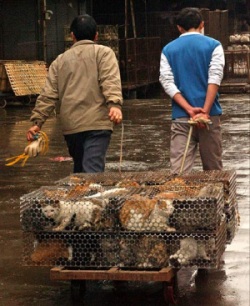 Many of our decisions cover the treatment of other living creatures. Do we eat a steak for lunch? Do we use those prescription pills, knowing that studies were performed on animals? Every culture has a different level of respect for different animals, with a different sense of what is “taboo” and what is not “taboo”.
Now, this may come as a little shocking, but dogs and cats (among other strange things, in Western eyes) are still considered food in many parts of Asia. It has started to become something of a taboo, but only for Westerners and the younger generation; many of the older folks don’t see things the same way.
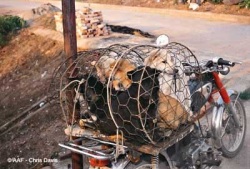 What is even more shocking is that there are reports that in some places in China, cats and dogs are taken off the streets and killed for their fur. Some of this fur may even have made its way overseas, and could be sitting in your home right now. Now, what is yet even more shocking is the apparently barbaric and cruel manner in which this is done. Not only is it enough for them to take what is probably a stray but could be someone’s pet off of the road and stuff them in a cage along with dozens of other animals, but they then bash the poor thing senseless, hang it, skin it alive, and then toss the still-living and breathing carcass onto a heap, where the animal is left to wail in pain as it slowly dies.
Now, I don’t know if these reports are true or not, but given the depths to which the human soul can sink, I can not discount the possibility completely. It’s very obvious that animals can be exploited for fur, and it’s also possible for the creature to still be alive and aware even after being bashed over the head. I read this story in a fundraising pamphlet by your favorite animal rights activists, so again, I am not sure how much of the story is sensation and how much is truth. However, I have to accept that there is probably some level of truth in there, and that alone leaves me feeling horrified.
So not only do they eat animals that we consider as pets, but some of them even see our furry friends as nothing more than mere agglomerations of physical matter, to be stripped and discarded of like ore from a mine!
Exploiting our cohabitants
However, aren’t we being a little hypocritical in a sense? You see, we heavily exploit animals when it comes to food. We have built an entire industry around the wholesale slaughter of cows, pigs, chickens, and seafood for the consumption of meat. We consider these animals as nothing more than the property of the human race, to be eaten or disposed of at our pleasure.
 Why is it that these animals seem to have less rights? Is it because they’re simply not as cute, like our friends to the right? Or perhaps it’s because we think that some animals are too dumb to be treated as nothing more than walking food. There seems to be a double standard: One standard for the animals we think are cute and intelligent and that we anthropomize to a certain extent, and another standard for the rest of the animals that we don’t care about. This is also culturally relativistic: Some cultures eat cows, while others see the cow as sacred. The standards vary from place to place.
One justification for the consumption of animals as meat is that we are built as omnivores. We are built to eat both animal matter and plant matter. We evolved in an environment where big game animals were plentiful, and we learned how to hunt them with spears. As we became smarter and better at gathering high quality food, the increased nutrition allowed our brains to grow larger still. This feedback loop is how we became an intelligent, yet aggressive species. Instead of hunting with claws, we used spears.
By eating meat, we are simply continuing our place in the ecosystem. Life and death form a circle; the lion and gazelle co-evolved and fill a niche in the African savannah. The lion has evolved to chase the gazelle, and the gazelle has evolved to run away from the lion. In our case, we’ve evolved to create ranches where we can raise animals until it is time to eat them. This is our expression of our place in the ecosystem.
However, is it really fair to continue to justify the consumption of meat, simply because it’s something we used to do? We used to kill the men and drag off the women from neighbouring tribes, too, but we don’t do that sort of thing anymore. We’re a modern, civilized species. Why do we continue to slaughter animals when it’s no longer a case of life or death? How can anyone justify the consumption of meat when there is such a wide array of vegetables, beans, nuts, and supplements? Isn’t the vegetarian way of life a little more civilized, even if we are not herbivores?
Ah, but not so fast! While it is true that vegetarians do not directly contribute to the slaughter of animals for meat consumption, they still contribute to the destruction of entire ecosystems. Just look at how much space a farm takes, and look at how much land is consumed for raising crops. Much of that land used to be forested, and all of that land used to contain an ecosystem that supported a diverse variety of wildlife, big and small! By consuming grains and other vegetarian staples, you have directly participated in the destruction of vast swaths of land for agriculture.
That cereal breakfast you enjoy? Well, the grains in that cereal probably came from a farm where Bambi used to live, until some farmers cut down his forest and destroyed his home and his life. Who is the vegetarian to say that this is somehow morally superior to the consumption of livestock that would probably not even survive at all in the wild in their current domesticated form?
In the end, it is up for us to decide
Humans are the most intelligent and powerful species on this planet, and we have dominion over the earth. We obviously get to make the rules. We also like to pretend that we’re more than simply intelligent barbarians, and that we can treat our companions of the earth with compassion and respect. So, where should we draw the line when it comes to the treatment of animals? Do we stop performing animal studies, at the risk of humans dying? Do we stop consuming all animal-based products, at the risk of malnutrition and malaise? Do we stop wearing fur hats, at the risk of… vanity?
It might be a more important question than you think: what if one day, now or in the future, there is something out there that is more intelligent and powerful than us, and what if they are watching us and observing how we behave?
So, it’s a dilemma. Where do you draw the line?
Disclaimer: I am an omnivore and I believe that it is our right to use animals for the benefit of humans. I am ambivalent when it comes to the consumption of cats and dogs in foreign cultures, but I find the skinning alive of these same animals for fur to be quite cruel. I believe that given our unique position of power, we can exercise our power in a manner that demonstrates compassion. There is no point in subjecting a living, feeling creature to an agonizing death nor needlessly prolonging its suffering.
P.S. Please don’t search for “cats in cages” or “dogs in cages” in Google Images. Even with safe-search moderate, I saw some things there that I really wish I hadn’t.


Very thought-provoking post Kevin.
I’m sure that your readers (as I do) appreciate all the effort that goes into your writing. Your quality shines through nicely.
As for the topic itself–I wonder if we’re just not selfish enough. That might sound strange, but after researching eggs (yeah, you can laugh) I’ve realized that caging birds unfairly and pumping them with “crap” ensures that humans take in too much Omega 6–and virtually no Omega 3. Without the balance, cells mutate and cancer can proliferate.
Diseases can also spread through inhumane treatment of animals in 3rd world countries. Plagues are awful equalizers, but they’re equalizers, nonetheless. If we were really selfish, we might figure out what we’re doing to ourselves–and start treating animals with a lot more respect. So perhaps we’re not selfish enough. Either that, or we’re a bit thick, to drop an old British euphemism.
That’s a very interesting take on it, Andrew. If we were more self-interested, we would see that taking better care of our “food” would mean less disease and a healthier population.
Do you think that education is the key, or even possible? I imagine that many people read “grain-fed cow” and see that as a good thing. “Hey, these grains are good for me, so they must be good for my food, too!” I think that education is possible, but there’s a high ramp to be overcome. It makes me think of comparing different ice creams based on fat content, while ignoring the high sugar content. Or perhaps it’s like frying your food in good-ol’ cheap vegetable oil. Hey, it has pictures of carrots and tomatoes on the label, so it must be healthy, right? 😛
Always appreciate your comments, Andrew!
This article is quite sad indeed. I eat fish and chicken but am not against eating beef and pork. I couldn’t imagine eating dogs and cats. However, I see the hypocrisy you suggest in passing judgment conveniently upon those who you perceive to do “worse” than you. Clearly,the cruel treatment of animals should not be tolerated.
I suppose it would also be sad if one were to go to one of those huge industrial operations and see how things go on there. Can we feed everyone with organic, grass fed beef and other livestock? I don’t know. I don’t mind not eating meat every day, but I won’t stop eating all animal products because I don’t believe that is healthy. I seem to have some problems with grains, so I’d have to cut out a whole class of foods were I to go vegan.
If one day technology were to be perfected to be point where we could “grow” meat, that would be pretty cool and I think it would solve a lot of ethical issues for the vegans and vegetarians out there! It might take some time before that gets perfected though. Last I heard, the “meat” ended up being more like slime than anything else!
I agree, very thought-provoking post.
I eat meat, and if I really think about it, I feel bad about it sometimes. It just seems like nothing is safe to eat anymore. Eggs will give you salmonella, spinach will give you e-coli, home canning your tomatoes will give you botulism, eating meat makes you a bad person, not to mention beef will kill you. You just can’t win.
It is funny because when I see a calf, I feel bad that people eat veal. When I see a cow, I feel bad that it may end up on the slaughterhouse. However, I still enjoy a good burger.
If I really looked into how animals are slaughtered, I would go insane. I still can’t get the image of elephants being brutalized for their ivory, and I saw those images 10 years ago. However, I do think humans eating animals is part of the natural cycle, although I am sure many would agree with me. I just wish it could be done more humanely.
I guess the question is where you define your morals, and at what cost? I wonder how many vegetarians would rather starve to death instead of killing a rabbit and eating it, were they stranded in the wild somewhere? Clearly at the most basic level, eating meat for survival cannot be immoral, for if it was, that would imply that the animal has more of a right to be there than we do, and we should all just kill ourselves right now for all of the room we take up on this world and give it back to the animals. I don’t think anyone truly believes in that, though, which is why there will always be gray zones when it comes to these subjects.
Thanks for commenting, and yep, watch out for that botulism! 😉
I love animals very much but I would stamp a rabbit to death if my life depended on it…. Most human’s would. In fact most of us would eat another human if we had to and that’s been proven quite a few times!
I guess we have to set our morals based on how we act in healthy circumstances.
Very thought provoking Kevin, when it comes to Ethics there are no absolutes.
Ethics will differ from one person to another, some people or communities might share common ones but you will rarely find a set unanimously agreed upon among humans as a species.
We have to accept that since knowing our nature, i will not be changing anytime soon.
Cheers!
Hey Mich,
I think the most important thing is to be tolerant. It’s arrogant to believe that because you live your life one way, that it is the “right way”. Other ways might seem strange, but it doesn’t make them wrong. On the other hand, we can probably all agree that bashing cats and dogs over the head and then skinning them for fur does seem rather barbaric! I don’t know what it feels like to be the person in charge of the skinning. How do they do it?
I draw the line at not eating veal, dogs, cats and horses. Wild game is preferable to domesticated meat sources. Perhaps we should all become vegetarians a couple of days a week.
I have heard the same, though it might be difficult to feed a lot of people on wild game. 😉 I am interested to see how health is going to play out in places like China. They are drastically increasing their consumption of meat, especially pork… and it’s going to take some intensive farming practices to provide it to hundreds of millions of rising Chinese.
Hard for us to imagine, even if it is a different culture.
I guess you do what you have to do if you life in a poorer country.
Yep, which is why we need to encourage the free exchange of ideas, goods, and people. Poverty (and all the various causes of it) is actually more destructive to the environment; if you want to see an extreme case of this, look at the border between South Korea and North Korea. Notice how the northern side doesn’t have trees… why? Because they were all cut down to provide heat and fuel. As much as my heart goes out for cats and dogs being skinned for fur, the fact that people can live in such tyrannical and oppressive conditions is far worse, at least in my view.
I have seen those images you advised not to look for. Makes my heart bleed.
I could write and discuss and condemn (myself and others) all day on these subjects. It would turn into a one man rambling show with no audience so I have to curb myself and cut it short….. Anyway here is a little ramble.
Vegetarianism: I am a vege for about 10 years now. I don’t think I am morally superior but I do know that humans have been surviving as vegetarians for thousands of years so the argument that it’s a recent thing is bs (check out Southern India and many Asian areas). I believe that in this modern world we have the physical choice to not kill and animal for food and clothing. To ignore that choice to me is completely morally wrong. However of course I am not perfect, I slip up from time to time but importantly I try.
Impact of mass industry: No matter who we are if we choose to be a part of society in the current world then we are attached to atrocities that are negatively affecting animals and humans alike. That bottle of mineral water could be doing a small toen out of water, a $10 bargain shirt could have resulted in even lower wages for a battery factory when the Western chain asked for cheaper production. The only way to avoid it is to separate yourself completely from society. However we can all make steps to make it better. Growing our own food (just started myself), buying responsibly (check out KnowMore.org to profile companies) and generally being aware. If cow fields were turned into grain fields you could feed over 5 x the amount of people with the same space and possibly save the ozone layer (cow farts are deadly and cow crap is killing fish, possibly causing cancer and much more!).
Culture and Animal Treatment: This is important….. Here in Egypt open respect for animals is rock bottom. It’s disgusting to see a kid kick a dog begging for food but seriously if a wild animal (that we don’t have as a pet) was to infest our Western cities we would probably turn to kicking and disgust. Just look at how pigeons and rats are treated. The atrocities of the Western world could be seen as worse, just more hidden. The giant pig and cattle factories are just a hint of our mass barbarity. I strongly suggest you watch the documentary Earthlings for a taste of what animals we really are: http://video.google.com/videoplay?docid=6361872964130308142#
Morally we are all going to hell (I don’t believe in hell but if I did…..). Unless we all start taking steps to make our treatment of this earth better our future generations will suffer the force of the kickbacks the convenience of society brings us. At least a giant antibiotic resistant disease will wipe out most of humanity, at worst a nuclear explosion will turn pigs into the ruling being and they will imprison us in giant metal tin shacks living in our own crap to breed to feed the new pig nation….. Ok maybe that won’t happen but something bad is coming!
I better stop….
Hey Forest,
You clearly have a lot of love for the planet we live on and the life that inhabits it. Don’t you think that continual advances in technology are the main way we are going to get out of this mess? Old technology is dirty, inefficient, and destructive; new technology is clean and efficient by comparison.
If one day we have something like a Star Trek-style replicator, that would be quite cool and would solve most of these moral issues. I don’t know if I’ll live to see that day, but who knows! I believe in continually extending lifespans due to improving technology. You’re completely right about the pitfalls becoming more dangerous as we go on, which is why we have to work hard at compensating technology for these pitfalls. I am more scared of a superbug run amok than nuclear explosions, though both would be devastating.
Thanks for the rant!
I definitely think that if we are morally responsible technology can help save a lot of problems. We are steadily outgrowing this planet and at some point a move will have to happen!
I’m extremely interested in the use of cell reproduction to create meat without a brain but am worried that it will be heavily genetically modified and be just as bad for us as all the crap around today!
The problem is…. Can a business and money led world honestly be morally responsible?
“The problem is…. Can a business and money led world honestly be morally responsible?”
The truth is that the power is in each and every one of us. We are all not just consumers, we are also producers. Everyone one of us is a business, and money is nothing but a means of exchanging value with other people. There is no objective morality, but there are incentives. A system which relies on the cooperation of individuals and which leaves individuals mutually better off after trade offers much better incentives than a system which steals from some people to give to others. Perhaps it seems disintuitive, but coerced collectivism turns people into nasty individuals that don’t cooperate very well with each other. The biggest shitholes on this planet are those places where collectivism runs amok and power is invested in the party, which, although they claim to represent the people, really represent the elite.
No political system except a system which recognizes that only voluntary exchanges leave both parties better off is ever going to truly improve this world. If you look at what has made a real difference over the last 100 years, it has been those voluntary exchanges, not the might of the fist. Imagine how much better off we’d be today if we hadn’t spent the first 50 years of the last century trying to kill each other off… imagine a Germany and Japan that had put all of their energy into building good cars and technology right off the bat, instead of trying to conquer the world, and imagine a Russia and China that hadn’t raped their own people for decades. That is the danger of ideology. I’ll send you some further reading by email if you’d like 😛
Intersting post and it’s difficult not to be tied up in this issue. I also think it’s difficult not to take conflicting viewpoints, no matter what side of the issue you sit on.
Also, im glad you came by to leave a comment. I just figured i’d let you know that the comment you left on my blog got stuck in the spam que.
I agree; the issue is fraught with complexity. You cannot consistently be against all use and death of other life without ceasing to exist yourself. Everyone has a different point where they draw the line.
P.S. Thanks for unspamming me!
Very thoughtful article. I have lived on small family farms for the better part of 20 years after having lived in the city. Yes, it is absolutely true that the COMMERCIAL meat manufacturing business can get very brutal. But, I believe it is important to recognize that it is these big conglomerates that are trying to run the small farmer out of business. Monsanto is the big one in the seed business. Why? Once these major businesses control our food supply they control us totally and make all the money in doing so. Laws are making it extremely difficult for the small farmer to exist and even more difficult to sell their meat directly to you. In 1900 98% of the poplulation lived on small farms. Now the percentage is 2%. And this two percent is getting bowled over on one side by big agri business and on the other by well meaning people who are trying to provide the safety and well being but aren’t aware of the whole picture.
I raised our family cow (beef) until they were three years old. They had food, water, and protection from predators. Then the butcher would come. They were put down in an instant. An instant after a life of romping, health, and fresh grass and hay. It was hard on me but I often thought that most people and pets have it worse as they live their lives out with disease and ultimately death. And, all I ever though about was what can I do to improve their lives. Others may express it different but I think this is the mind set of most family farmers.
Sorry to be so long winded but the voice of the family farmer is being drowned out. Do we love our animals? Yes we do or we wouldn’t desire to spend our lives among them in a situation that has long since has had most of the profitability sucked out of it. Please support the family farms. They are the only thing standing in the way of the agri businesses taking over our entire food supply.
Carol,
Do you feel, as I do, that it’s completely and totally ridiculous that Monsanto can hold a patent over their seeds, and come after you if some happen to blow onto your farm in the wind and start growing in your fields? How do you feel about agricultural subsidies and the impact that they have?
Thanks for stopping by. I really appreciate the perspective from someone who experiences these issues first-hand and who has such a crucial role in our food supply!
Yes, the fact that Monsanto is taking over is absolutely scary because it is happening so quietly. I’m going to be putting links to the heritage seeds on my blog. Awareness is always step #1.
I tend to see it how you expressed it in your Disclaimer, in broad terms. I think that many of these things could be done based on needs, rather than wants. Frankly, certain animals have been a source of food in different regions of the world throughout history. It that such a bad thing?
When the tiger hunts down the gazelle and tears off all the meat, clearly it’s a horrible, cruel experience for the gazelle. When I have seen these type of nature shows on TV over the years, I root for the poor prey to escape!. It seems horrific. However, it is what it is. After all, how can we hold it against an animal that needs to hunt for survival?
Yet when people do it, it’s mean? Hmmmm….
I remember visiting China 20 years ago on an academic trip, and seeing a market where cats were for sale. To be eaten. Snakes were for sale for that purpose too. It offended my Western “sensibilities”, especially at a young age. But hey – if that’s what they do there, what can I do about it?
In terms of using animals for medical trials, it’s worth thinking about what one would do if the situation was personalized. For example, if 10,000 innocent dogs and cats (I’m making this up here) needed to be used in clinical trials to help find a cure for a specific, rare cancer, would you care? I think many people would react in a range from flinching at that to being outraged. However, what if it was very dear member of one’s family who had that cancer, and these trial could possibly save her life. Would one’s reaction change? Probably, I would guess. That’s what it comes down to in my view.
Again, I emphasize the need to do these things with kindness and compassion. I don’t think animals should be skinned for furs, killed purely for sport, etc. These are living creatures that we should treat kindly and humanely.
Right, many of the ideas that we hold to be universal are really culturally relativistic. I can’t imagine eating a dog or cat, not only because I’ve had dogs and cats as pets and I would find it very strange to eat them, but also because I imagine that it would taste disgusting. However, other cultures have different ideas about these things. Just because it’s strange to us doesn’t mean that they’re wrong.
It’s not a black and white issue. There’s a difference between animal research, eating food, and holding a frog over a flame for kicks. I don’t believe in unnecessary cruelty and killing for the pure sake of it, but if one were to be against all death, than one could not live. By our mere existence we kill many lifeforms every day. It’s part of the circle of life.
That is cool that you were able to travel to China 20 years ago! The country has changed so much since then; how was the trip? Which parts did you visit?
I don’t think ANYBODY who eats meat is allowed to protest or complain about animal cruelty or rights at all. It’s hypocritical to do so.
Can vegans complain about poor agricultural practices? 😉
We are all hypocrites really….. But we still have to have aims and wishes even if we are far from perfect ourselves. When I rant and rave the rants are aimed at myself as much as anyone else. I have much criticism towards myself and many improvements to make and sometimes shouting about what my deep inner self believes is enough to get me to change my own ways…… No I don’t have multiple personality disorder 🙂
When helping my 8 year old son research a little bit on consumer animals, I stumbled across this post. I just wanted to say, Bravo for a well written post. This is provoking and charged, yet rational and down to earth at the same time.
I’m glad that you enjoyed the post and hope that it helped out!
Fascinating! We began purchasing whole cows from the local farm last year, and it’s working out really well for us. We found a great website with lots of great dishes like this meat recipes to keep us going.
We did like that aswell, buying beef whole from the local farmer. I like to support them, even if it is a more expesnive than the supermarket, because I know exactly how and where it is made, I know I’m not contributing to our carbon footprint or something. This meat recipe is good, I found.